Oyo State is set to partner with the Consultative Group for International Agricultural Research (CGIAR), the world’s largest publicly-funded agrifood research network, which has the International Institute for Tropical Agriculture (IITA) as one of its research centres, on advancing cassava and cocoa value chain.
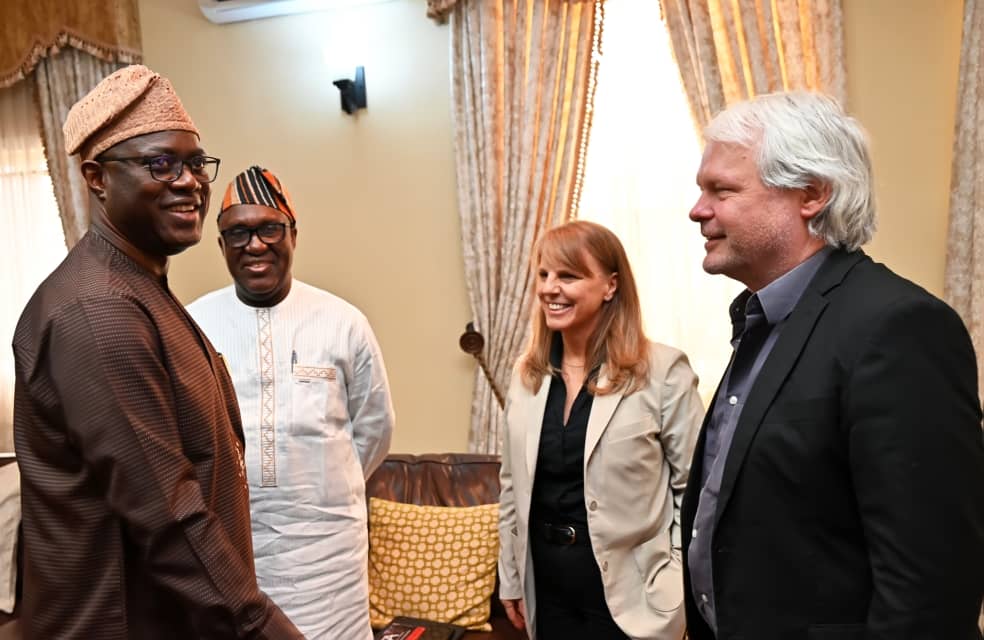
Sandra Milach, Chief Scientist of the CGIAR and the Deputy Director-General of the IITA, Bernard Vanlauwe, stated this on Friday, shortly after a meeting with the Oyo State Governor, ‘Seyi Makinde, noting that the state has great potential in agriculture and that having invested in processing and value addition, it will benefit from the partnership, which is aimed at developing plans on how to advance cassava and cocoa value chains.



















Speaking with newsmen shortly after the meeting, which had in attendance the Director-General of the Oyo State Agribusiness Development Agency (OYSADA), Dr Debo Akande; and the Senior Executive Assistant on General Duties, Chief Bayo Lawal, Milach noted that the partnership would enable Oyo State, as one of the major producers of cassava and a state with potential in cocoa production, to understand what is important as well as the bottlenecks of the value chains the state is working on and how it can be assisted to find solutions.
She added that the CGIAR will work hand-in-hand with the Oyo State Government to help to understand and come up with solutions on the processing industry’s roles in helping farmers adopt better varieties of cassava and cocoa and connecting the value chain from end to end to ensure food security, boost agribusiness and uplift farmers.




“We just met the governor, and we talked especially about cassava. We know Oyo State is one of the major producers and it is also investing in processing and value addition.
And we talked about cocoa. So, these are the two crops that IITA has a lot of expertise in. And we have agreed to develop plans together with the governor, on how we can advance both value chains,” Vanlauwe said while corroborating Milach on the purpose of the meeting with the governor.
Earlier, Milach said: “I lead the science of CGIAR, we are the largest global agriculture public goods organisation. We have a very important mission, which is how to continue helping farmers and communities across the globe in transforming food systems, water, land as well as systems.
Our focus is to create food security for the African continent, and for other parts of the globe as well. But Africa is a very important continent for us.
“So that is why I am here spending a full week with my colleague, Bernard, and with also important partners, and it has really been a very important week of learning.
“You have a wonderful country, and Oyo is a wonderful state, with a lot of potential for agriculture, for food transformation. We are very aligned with the governor and with the leadership of Nigeria in this mission.”
She added that the partnership would equally help the state to bolster its achievements in agribusiness development, as according to her, science has an important role to play in raising value proposition of agribusiness.
She said, “In CGIAR, we are really on this mission of asking the question, how can we turn all the science we do into a real value proposition, real business? We see a very important role for our science to help to raise the value proposition of business.
“So, this is what we are here for. Just to help to raise that proposition; working hand-in-hand with the state, the governments, to understand what really is important; what really are the bottlenecks of the value chains that you are working on.
“How can we assist you to create evidence for what needs to be done? How can we bring science to you, so that you can really find solutions?”
Addressing how the partnership will specifically help people in agribusiness and farmers seeking economic empowerment through agriculture, Milach added: “First of all, we need to understand the problem we are trying to solve.
In the conversation with the governor, we saw that the chance is very real on how we produce cocoa in Oyo State and Nigeria, and how to produce more.
Understanding that chance is the first step. But it is equally important to understand within the cocoa production value chain, what are the bottlenecks we have, because sometimes, you can have science, technology but the bottlenecks will slow everything down.
“How can we understand what the bottlenecks are, is it in the processing, is it in the infrastructure, roads and all that? All these we have to understand. There is also an important role for the processing industry to help farmers to adopt better varieties, because they need to have a clear understanding on what types of variety of cocoa or cassava they need and the yield they are willing to have.
That pull from the processors will help to uplift the farmers and help them to get real markets and real sale of their produce, because if you produce something that people are not willing to buy, there is a problem.
“So, how to connect that value chain from end to end is important; understanding the problems from the farmers’ side to what the industries are requiring will help us to make this value proposition for the value chain.”
The delegation was led by the Director-General of IITA-CGIAR, Dr Simeon Ehui. Others on the delegation include Dr Tahirou Abdoulaye, Dr Ibnou Deng, and Mrs Toyin Oke.
Signed
Dr Sulaimon Olanrewaju
Special Adviser (Media) to Oyo State Governor
June 26, 2026.