
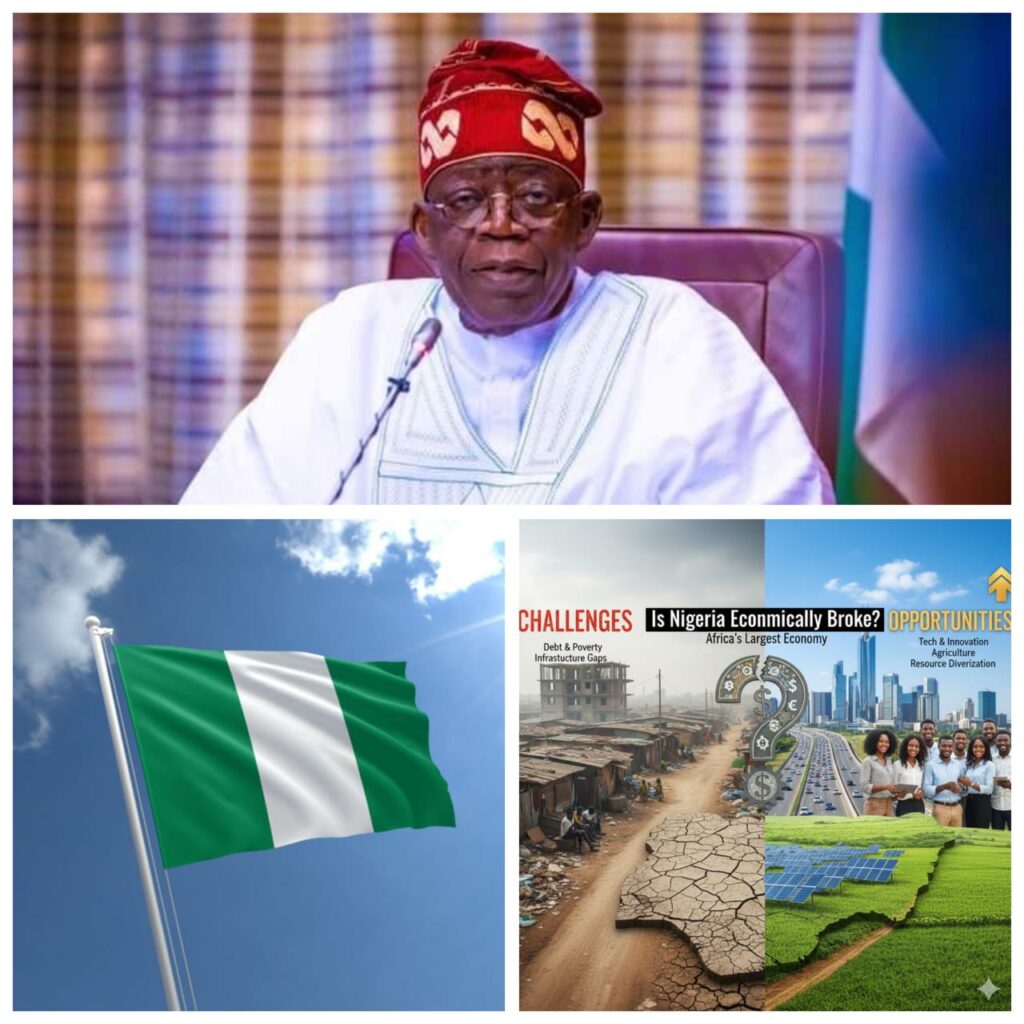
How Nigeria loses trillions through discretionary land administration, while Singapore and Dubai turn land into a predictable revenue engine.
The real danger to a country is rarely bankruptcy — it is the quiet bleeding that no one stops. Nigeria is not empty; it is being emptied.
Nigeria’s crisis is not mysterious. It is engineered — a system deliberate, predictable and profitable for those fluent in its disorder.









From traffic lights treated as polite suggestions to land allocations negotiated in backrooms, the country has perfected a paradox: a state desperate for revenue that casually steps over the wealth lying in plain sight. And when a nation keeps losing what it already has, the question is no longer about revenue — it is about responsibility.

The real damage happens inside the system — in the way land is allocated without transparency, in the way public contracts are inflated beyond reason and in the way national assets quietly migrate into private hands.
These are not accidents; they are patterns. And every pattern of loss, left unchecked, becomes policy by default.
Land is one of the most powerful economic tools any government possesses. It can be a source of predictable revenue, a foundation for long‑term planning and a catalyst for urban transformation.
But in Nigeria, land has become something else entirely: a political bargaining chip, a patronage asset and a silent drain on national wealth.
Across the country, governors and land officials wield extraordinary discretionary power over allocation, pricing and documentation.
The result is a system where land is often given away far below market value, allocated without competitive processes and documented through a maze of opaque approvals that discourage investment.
Every year, trillions of naira slip through the cracks — not because the land lacks value, but because the system lacks structure.
Contrast this with Singapore, where land is treated as a strategic national asset. Every parcel is mapped, valued and managed through a transparent framework that feeds directly into public revenue, infrastructure financing and long‑term urban planning.
Or Dubai, where land is leveraged as a growth engine, with clear rules, predictable pricing and a digital land registry that leaves little room for discretion.
These cities did not become global economic hubs by accident. They built land systems designed to maximize value, reduce uncertainty and ensure that public assets serve public goals.
Their success exposes a painful truth: Nigeria’s land problem is not about scarcity — it is about governance.
As Nigeria pushes for economic diversification, fiscal stability and sustainability, land should be one of its strongest levers. Instead, it has become one of its biggest leakages. Understanding how this happened — and how others avoided the same trap — is the first step toward turning chaos into cashflow.
The Twin Engines of Dysfunction: Land Opacity and Procurement Inflation
Nigeria’s dysfunction is powered by two mutually reinforcing engines: opaque land allocation and inflated public procurement.
One transfers public assets to political insiders at token prices. The other buys them back at wildly inflated ones.
Between land handed out cheaply and contracts awarded expensively, the state manages the rare feat of losing money on both sides of the ledger. It is not merely inefficient; it is a system designed to privatize gains and socialize losses.
The Land Allocation Black Hole
Nowhere is Nigeria’s governance flop more visible — or more expensive — than in land administration.
In prime districts, government land worth ₦110 million in the open market could routinely be allocated for ₦10.5 million.
Within weeks, it is resold for hundreds of millions. The allocatee becomes wealthy overnight. The state earns almost nothing. Robbed.
This practice has quietly reshaped Nigeria’s housing market. It inflates land prices, deepens the housing deficit and pushes honest buyers out of reach. It also deprives the government of revenue that could fund schools, hospitals and affordable housing.
In most countries, this would be a national scandal. In Nigeria, it is Tuesday.
Global Contrast: How Functional States Treat Land
Nigeria’s land economy is not just inefficient — it is irrational, when compared to countries that treat land as a public asset rather than political patronage.
Singapore: Land as a National Wealth Engine
Singapore sells state land through the Government Land Sales (GLS) program — a transparent, competitive, sealed bid auction system. Every bid is published publicly. No official can allocate land to a crony. No plot is sold below market value.
The result?
• Singapore earns between $3.8 billion and $4.1 billion USD annually from land leases — that is ₦5.7 trillion to ₦6.15 trillion.
• By comparison, Lagos — widely regarded as Nigeria’s gold standard for internally generated revenue — recorded just ₦14 billion from Land Use Charge in 2024.
• This is a very tiny fraction of what an orderly, well‑governed city‑state like Singapore earns from its land‑value system.
• A single city‑state, smaller than Lekki in Lagos, generates the equivalent of 8–9% of Nigeria’s entire 2026 national budget — purely from transparent, well‑structured land administration.
• The city‑state also keeps speculation on a tight leash. Developers must build within five to seven years or face stiff penalties.
• Land is leased for 99 years, as in Nigeria on paper, but the rules are enforced with a rigour that ensures long‑term value flows back to the public purse rather than to private hoarders.
Singapore captures land value for the public. Nigeria transfers land value to private pockets.
Dubai: A Digitized, Rule-Based Land Market
Dubai offers another study in contrast. Its property market runs on a rigidly formalized, digitized chain.
Every sale requires:
• A licensed agent, a standardized Memorandum of Understanding (Form F), a 10% deposit, a developer’s No‑Objection Certificate and a final transfer at a Land Department trustee office, where digital title deeds are issued instantly.
• The system is designed to eliminate discretion — and the revenue reflects it. In 2024 Dubai earned roughly $5.7 billion (₦7.8 trillion) from direct real‑estate transactions.
No shortcuts. No backroom allocations. No political gifts.
Nigeria, by contrast, preserves discretion because it monetizes it. The country’s land market is large enough to matter, but too informal to tax, too opaque to regulate and too politicized to reform.
The examples of Singapore and Dubai show what is possible when land is treated not as patronage but as policy — and how much Nigeria continues to leave on the table.
The Human Cost of Nigeria’s Dysfunction
Behind every inflated land price is a family priced out of home ownership. Behind every opaque allocation is a young professional condemned to lifelong renting. Behind every political land deal is a school unfunded, a hospital unbuilt, a road unrepaired.
In elite enclaves of Abuja and Lagos, land alone accounts for 50–70% of the purchase price of a home. Before a single block is laid, the dream of ownership has already been priced out.
Nigeria’s land allocation system is not merely inefficient. It is extractive.
The Urban Economics of Disorder
Nigeria’s land crisis is not just a governance disaster. It is an economic distortion that reshapes cities, inflates costs, and traps millions in a cycle where housing becomes both unaffordable and unattainable.
Titles are contested. Registries are fragmented. Allocations are discretionary. This uncertainty is monetized. Buyers pay premiums for “connections.” Developers build the cost of delay into final prices. Speculators flip land rather than develop it.
The result is a housing market where prices rise not because value is created, but because opacity is profitable.
The Shadow Real Estate Economy
Nigeria’s land market is vast in theory but anaemic in practice. The country’s real‑estate sector is valued at ₦41.3 trillion ($30 billion), according to the National Bureau of Statistics’ 2025 GDP‑rebasing exercise. Yet more than 70% of transactions occur informally. Lagos alone hosts some 80,000 self‑styled “agents”, most unregistered, unregulated and with no tax footprint.
The result is a market in which discretion substitutes for policy and the state captures little of the value it enables. Irregularity bends urban development out of shape: it encourages land hoarding, drives up the cost of construction finance and pushes developers toward high‑end projects where margins can absorb speculative land prices.
The outcome is perverse. Government recovers almost none of the value created, even as it bears the cost of the infrastructure and services that make the land valuable in the first place.
Empty Houses; Dead Capital
Abuja is dotted with thousands of unoccupied houses — properties built not to shelter families, but to store wealth.
They generate no rental income, no property taxes, and no economic activity. Economic analyses indicate that Nigeria has roughly $150 billion to $300 billion tied up in “dead capital” due to poor land administration.
In Dubai, this would be impossible. In Abuja, it is routine.
What a Functional System Would Look Like
Reform is not complicated; it is merely inconvenient for those who profit from the current arrangement.
A functional land‑administration system would:
• Publish all allocations online in real time,
• Auction plots transparently at market value,
• Digitize registries to eliminate duplicate titles,
• Introduce property taxes that fund local development,
• Strip political discretion from allocation committees,
• Create a national land valuation framework.
These reforms would generate billions — sustainably, fairly and without raising taxes.
The Procurement Premium
If opaque land allocation is one hole in Nigeria’s public finances, inflated procurement is the other — deeper, darker and far more lucrative.
A vehicle priced at ₦40 million becomes ₦65 million. A generator worth ₦15 million is invoiced at ₦48 million. A laptop retailing for ₦450,000 appears in official budgets at ₦1.2 million.
Such padding endures not because the mechanics are complex but because the incentives are well‑aligned. Inflated procurement has become one of the most dependable channels for distributing favours and sustaining political networks — a system too entrenched to reform itself.
The High Price of Non-Enforcement
Nigeria’s refusal to enforce basic rules is not benign. It is expensive. It is a self‑inflicted fiscal crisis.
A country that loses an estimated ₦4–₦5 trillion annually to tax evasion behaves as though rules are optional and revenue is decorative.
Every ignored traffic violation is not just chaos on the roads; it is billions in fines uncollected.
Every unapproved building is a penalty politely declined – Lagos alone counts tens of thousands of such structures.
Every expired vehicle paper is a fee the state has chosen to forfeit; compliance in some states hovers below 40%.
In Nigeria, opacity is not a glitch but a governing principle: every murky land allocation quietly shifts public wealth into private hands —an annual leakage of roughly ₦7 trillion.
Dr. Olisa Agbakoba SAN — a respected voice not frivolous with data — says weak fiscal management, oil‑sector sleights and general inefficiency drain as much as another ₦20 trillion annually.
Every inflated contract is a budget drained before the first shovel hits the ground; procurement “padding” routinely adds 20–30% to project costs.
Nigeria is not broke. It is simply a country that leaves its money lying around—and then wonders who stole it.
A Path Back to Credibility
Nigeria can rebuild its institutions — and its reputation — by embracing three principles:
- Enforce the laws already on the books.
- Digitize processes to eliminate discretion,
- Make land and procurement systems transparent and market based.
Enforcement is not punishment. In functional societies, it is policy.
Nigeria’s Wealth Is not Missing. It is Being Handed Away.
Land is given away for far less than it’s worth, and public contracts are awarded for far more than they should cost. It is a closed loop of loss — assets handed out at a discount and bought back at a premium.
But cycles are not destiny. And this one is begging to be broken.
No tax reform, no budget speech, no foreign loan can save a country that keeps letting value slip through its fingers — from the moment land is allocated to the moment a project is abandoned to weeds and weather. Because the truth is simple: a country can earn and borrow billions and still grow poorer, if its systems are designed to leak more than they keep.
Nigeria is not starved of resources; we are starved of stewardship. Yet that is the one thing we can change, the one lever fully in our hands.
The time has come to shut the back doors, seal the leaks and reclaim the wealth that already belongs to us. To turn our resources into roads that last, schools that work, hospitals that heal and opportunities that endure.
Nations don’t go broke; they bleed from the places where accountability should stand guard.