
The release of the All Progressives Congress (APC) manifesto in Oyo State has opened another chapter in the political debate over the direction, achievements and future of governance in the Pacesetter State.









While political parties have every right to present alternative policies, challenge an incumbent government and promise a better future, such promises must be subjected to critical examination.
A manifesto should not merely contain attractive proposals; it should demonstrate an understanding of the existing development landscape, identify genuine gaps and explain how its proposed policies will deliver better results.
This is particularly important in Oyo State, where Governor Seyi Makinde’s administration has operated under identifiable development frameworks covering infrastructure, education, healthcare, agriculture, security, technology and economic growth.
The central question, therefore, is not whether APC has the right to make promises. It does. The more important question is: What exactly is APC promising that has not already been initiated, implemented or substantially addressed by the present administration?

And where APC criticises the Makinde government, what verifiable evidence supports its allegations?
A closer examination of the issues raises important questions about the originality, consistency and practical credibility of some of the opposition party’s proposals.
- Oyo State Does Not Lack a Development Direction
One of the weaknesses in the APC’s argument is the suggestion that Oyo State needs an entirely new development direction to make meaningful progress.
That position does not adequately acknowledge the development frameworks already introduced by the Makinde administration.
Since assuming office in 2019, Makinde has operated with successive development roadmaps, including the Roadmap for Accelerated Development 2019–2023 and the Roadmap for Sustainable Development 2023–2027.
These frameworks cover economic development, education, healthcare, infrastructure and security.
The administration has also pursued Agenda 2040 as a longer-term development framework.
These are identifiable policy directions, not an absence of planning.
Indeed, in his June 2025 State of the State Address, Makinde outlined projects and interventions across the state’s major development sectors.
This does not mean every objective has been achieved or that the government should not be criticised. However, APC must distinguish between an existing policy that requires improvement and a sector that has been completely neglected.
The opposition’s responsibility is to identify specific failures, explain why existing interventions have not delivered sufficient results and demonstrate how its proposed alternatives will perform better.
It cannot credibly suggest that development in Oyo State begins with its manifesto.
- The ₦150 Billion IGR Target: Ambition Without a Complete Financing Strategy?
APC’s promise to increase Oyo State’s internally generated revenue to ₦150 billion annually is one of the major economic highlights of its manifesto.
It is an ambitious target, but increasing internally generated revenue is not an entirely new economic philosophy.
The Makinde administration has also pursued revenue expansion, improved revenue collection and efforts to strengthen the state’s economic base.
Oyo State’s 2024 Citizens Accountability Report puts actual IGR at approximately ₦65.29 billion, representing 27 per cent growth over the 2023 figure of approximately ₦51.24 billion.
That figure is important because it provides a documented baseline against which APC’s ₦150 billion target can be assessed.
However, the opposition must explain the mechanics of achieving this target.
- Which economic sectors will generate the additional revenue?
- How much will come from taxation, fees, investment and commercial activities?
- What reforms will improve tax compliance without burdening ordinary residents?
- What safeguards will prevent multiple taxation and harassment of small businesses?
- What is the implementation timetable?
Promising to generate ₦150 billion annually without increasing the financial burden on residents and businesses sounds attractive. But a revenue target is not a revenue-generation strategy.
APC must provide the economic calculations behind its promise.
It must also demonstrate how the additional revenue will translate into improved public services and infrastructure.
- Local Government Autonomy Is Not an APC Invention
APC’s promise to grant local governments autonomy from its first day in office is politically attractive.
However, local government autonomy is a constitutional and national governance issue, not an exclusive APC policy.
Oyo State already has democratically elected local government representatives, and local councils have been involved in community development, infrastructure and other grassroots interventions.
The Supreme Court’s July 2024 judgment on local government financial autonomy also changed the national conversation around the administration of local government funds.
Therefore, APC must go beyond presenting autonomy as a slogan.
What specific legal and administrative reforms will it introduce?
How will it guarantee transparency in council expenditure?
How will it strengthen local government revenue generation?
What mechanisms will ensure that autonomy translates into functioning primary healthcare centres, better roads, improved markets and other tangible community benefits?
The people need more than a promise of autonomy. They need to understand how that autonomy will improve their daily lives.
- Road Infrastructure: APC Must Acknowledge Existing Investments
Infrastructure is another area where the APC manifesto requires closer examination.
It is reasonable for an opposition party to argue that more roads are needed across Oyo State. Indeed, no responsible government should claim that road infrastructure is no longer a challenge.
However, it would be misleading to suggest that the Makinde administration has not made significant investments in road development.
In his 2025 budget presentation, the governor reported the delivery of 118.07 kilometres of roads in the preceding year, including the 76.67-kilometre Iseyin–Fapote–Ogbomoso Road, named the Adebayo Alao-Akala Memorial Highway.
He also reported 43.46 kilometres of completed feeder roads and another 59.52 kilometres under construction at the time.
Furthermore, his June 2025 State of the State Address reported more than 100 kilometres of completed and ongoing feeder-road projects in Ibadan, alongside the rehabilitation of 87 kilometres of rural roads under the Rural Access and Agricultural Marketing Project (RAAMP).
These figures provide a basis for assessing the administration’s infrastructure record.
APC’s proposal to complete ongoing projects, construct additional roads and provide access roads to farming communities is legitimate.
However, its proposed 20-year road warranty raises another important question.
How will the warranty be enforced? Will contractors be legally bound to repair defective roads? Who will independently inspect construction quality? What penalties will apply when contractors fail to meet the required standards?
A 20-year warranty sounds impressive, but its credibility will depend on enforceable contractual provisions and adequate project supervision.
- Healthcare: What Is New About the Promise of Functional Clinics?
APC’s promise to establish functional clinics across all 351 wards in Oyo State is an important commitment.
But it is not an entirely new healthcare direction.
The Makinde administration has already invested in primary healthcare infrastructure and medical services.
According to the governor’s 2025 State of the State Address:
- More than 209 primary healthcare centres had been upgraded under Omituntun 1.0.
- A total of 264 PHCs had been equipped.
- Another 106 PHCs were undergoing upgrades.
- More than 18,000 residents had benefited from the Omituntun Free Health Mission in the first half of 2025.
- Recruitment of healthcare personnel had continued across primary and secondary healthcare facilities.
The administration also reported efforts to expand health insurance coverage to vulnerable residents, pensioners and students.
These interventions do not establish that healthcare delivery is perfect across the state.
There may still be communities experiencing shortages of doctors, nurses, medicines, diagnostic equipment and functional facilities.
That is precisely where APC should focus its criticism.
Rather than simply promising clinics, it should explain how it will address staffing shortages, guarantee regular medicine supplies, maintain medical equipment and ensure that facilities remain operational.
The real test of healthcare policy is not the number of clinics announced but the quality of healthcare residents actually receive.
- Education: APC Must Explain Its Proposed Improvement Over Existing Interventions
Education is another sector where the APC manifesto needs to demonstrate a clearer distinction between its proposals and ongoing government policies.
The Makinde administration has recruited 5,000 secondary-school teachers and subsequently announced a much larger recruitment exercise involving 14,500 primary and secondary school teachers in its 2025 budget presentation.
The government has also pursued school renovation, classroom rehabilitation and interventions aimed at returning out-of-school children to classrooms.
Its education agenda includes improving teacher availability and working towards a more manageable teacher-pupil ratio.
APC’s promise of 30 pupils per classroom must therefore be carefully distinguished from a teacher-pupil ratio of 1:30. They are not the same measurement.
One concerns the number of pupils sharing a classroom; the other concerns the number of pupils assigned to a teacher.
APC should explain how it intends to achieve its classroom target, recruit and retain qualified teachers, improve teachers’ welfare, provide instructional materials and address the condition of public schools.
It should also present measurable targets for learning outcomes.
The real question is not whether Oyo needs better schools. It does. The question is what APC will do differently to produce better educational outcomes.
- Agriculture: Building on Existing Interventions Rather Than Pretending Nothing Exists
Agriculture is understandably a major component of APC’s economic agenda.
Oyo State has enormous agricultural potential, and there is a strong case for expanding commercial farming, food processing, agricultural exports and rural infrastructure.
However, the Makinde administration has already pursued agricultural interventions through tractorisation subsidies, farm inputs, extension services, agribusiness development and rural access roads.
The government has also invested in the Fasola Agribusiness Transformation Centre and commenced the Eruwa Agribusiness Transformation Centre project.
These initiatives demonstrate that agricultural development is already part of the state’s economic strategy.
APC’s proposals on farmers’ insurance, export promotion and agricultural development may offer additional value.
But the party must explain how its proposed interventions will complement or improve existing programmes.
How many farmers will benefit from its insurance scheme? Who will bear the insurance premiums? What export markets will be targeted? What processing facilities will be established? How will farmers access affordable equipment and financing?
Agriculture requires more than political promises. It requires a coordinated value chain that connects farmers to inputs, finance, technology, processing facilities and markets.
APC should demonstrate how its proposals will deliver that value chain.
- Electricity: Acknowledging the 11MW Independent Power Project
APC’s electricity proposal is another area that deserves scrutiny.
The party’s promise to strengthen electricity regulation, encourage power generation and provide dedicated electricity to industrial and agricultural corridors is a welcome policy direction.
However, electricity development is not a completely unexplored area in Oyo State.
In December 2024, the Makinde administration commissioned the first phase of an 11MW independent power project developed in partnership with Elektron Energy.
The project comprises a 10MW gas-fired power facility and a 1MW solar solution. Its initial objective included providing continuous electricity to the Oyo State Secretariat, with supply expected to extend to surrounding communities.
The governor subsequently reported that the Secretariat was receiving 24-hour electricity from the project.
This is an important intervention that APC should acknowledge when presenting its electricity agenda.
The opposition should explain how its proposed electricity regulator will improve on the existing framework, attract additional private investment and expand reliable electricity supply to industrial and agricultural communities.
The question is not whether Oyo needs more electricity. It certainly does.
The question is what additional infrastructure and investment APC intends to introduce to bridge the remaining electricity gap.
- Security: The Amotekun Question
Security is one of the most sensitive responsibilities of any government, and no political party should trivialise the concerns of residents over insecurity.
APC is entitled to demand stronger intelligence gathering, faster emergency responses, improved rural security and better protection for farmers and communities.
However, it cannot reasonably present community-based security as an entirely new discovery in Oyo State.
The Makinde administration signed the Oyo State Security Network Agency Bill into law in March 2020, establishing the legal foundation for Amotekun.
The state also strengthened Operation Burst, supported conventional security agencies and introduced other security interventions.
According to the governor’s 2025 State of the State Address, 480 additional forest rangers were recruited into Amotekun in October 2024, bringing the corps’ reported strength to 2,500.
The administration also reported providing more than 50 additional operational vehicles equipped with communication gadgets to security agencies during the preceding year.
These are identifiable interventions, although their existence should not be mistaken for proof that insecurity has been eliminated.
APC should therefore provide evidence of specific security failures and explain how its proposed security reforms will address them.
How will intelligence networks be strengthened? What will be the response time to distress calls? How will rural communities and farmers receive protection? What additional resources will be allocated to security operations?
Security is too important to be reduced to political slogans.
- Digital Economy: Beyond Artificial Intelligence and Technology Slogans
APC’s proposal to develop Oyo State’s digital economy through artificial intelligence, software development, digital marketing and technology hubs is relevant to the changing global economy.
There is no doubt that technology can create employment, improve productivity and expand opportunities for young people.
However, digital development is not simply about mentioning fashionable technology terms in a political manifesto.
Oyo State has pursued technology-oriented governance, digital skills development and youth empowerment initiatives.
The opposition must therefore explain how its proposed digital hubs will complement existing efforts.
Where will the hubs be located? How much will be invested in them? How many young people will receive training annually? What partnerships will be established with technology companies? How will trainees access employment and business opportunities after completing their programmes?
Most importantly, what measurable economic contribution will these initiatives make?
A digital economy policy must go beyond training announcements. It must establish a sustainable ecosystem connecting education, innovation, investment and employment.
- Workers and Pensioners: What Is the Proposed Difference?
The welfare of civil servants and pensioners is another issue that deserves serious attention.
APC’s commitment to improving workers’ welfare and protecting pensioners is legitimate.
However, the Makinde administration has also taken steps in this direction.
During his November 2024 presentation of the 2025 budget, the governor proposed an ₦80,000 minimum wage for Oyo State civil servants, alongside the transition from the existing wage award arrangements.
The administration also reported paying health insurance premiums for 40,000 pensioners and students in state-owned tertiary institutions under the Oyo State Health Insurance Agency scheme.
It further announced plans to extend coverage to 100,000 vulnerable residents.
These are relevant policy interventions that should form part of any fair assessment of workers’ and pensioners’ welfare.
Nevertheless, the existence of these policies does not automatically establish that every worker or pensioner is satisfied.
APC should provide specific details about its proposed salary structure, pension payment schedule, promotion arrangements, retirement benefits and healthcare coverage.
It should also explain how its proposed improvements will be financed without creating unsustainable recurrent expenditure.
Workers and pensioners deserve measurable commitments, not political assurances.
- But Does APC Have No Valid Grounds to Criticise Makinde?
For the sake of fairness, it would be wrong to suggest that every criticism of the Makinde administration is baseless simply because the government has implemented projects and introduced development programmes.
That would be an equally weak argument.
A government can have an impressive development roadmap and still struggle with implementation. It can construct major roads while residents in other communities continue to experience poor access. It can upgrade healthcare centres while some facilities lack sufficient personnel and essential medicines.
Similarly, it can recruit teachers while public schools still require additional classrooms, instructional materials and improved learning outcomes.
APC’s strongest arguments should therefore be assessed against verifiable evidence rather than dismissed as opposition politics.
For instance, the party’s concerns about poverty, revenue generation, electricity access, unemployment, agricultural productivity and the quality of public services are legitimate areas for public scrutiny.
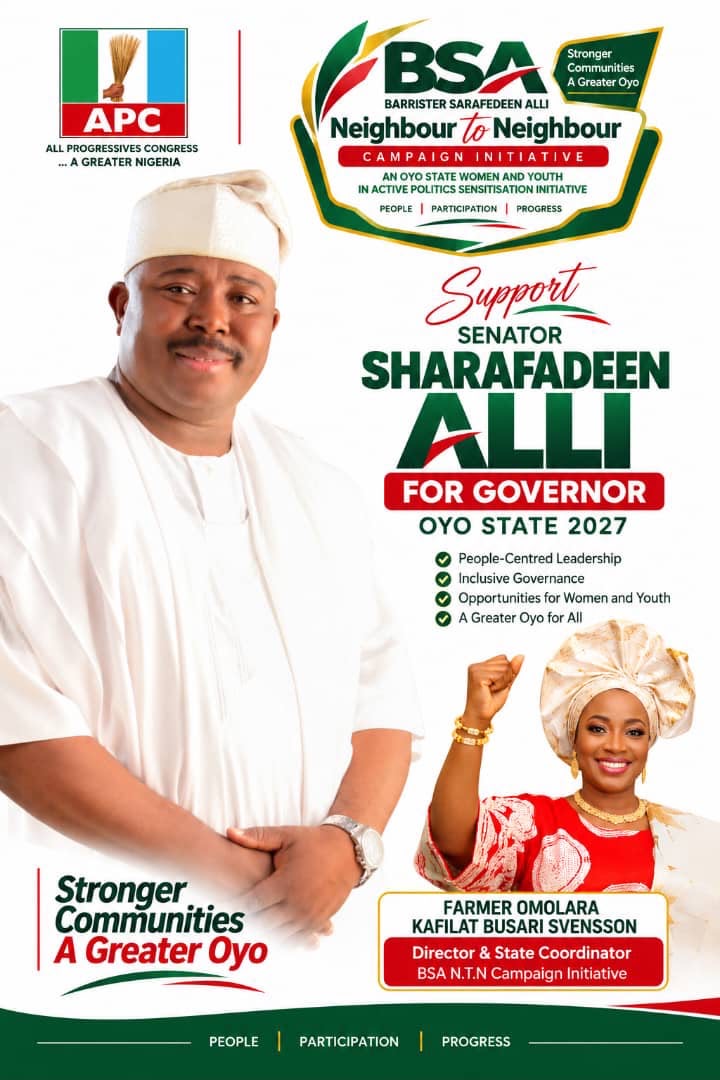
Its governorship candidate, Senator Sharafadeen Alli, reportedly cited an estimated 3.8 million people living in poverty in Oyo State during the unveiling of the manifesto. He also compared the state’s revenue performance with that of neighbouring Ogun State.
These claims deserve examination.
But the opposition must provide the underlying National Bureau of Statistics data, identify the reference year and explain the methodology behind the poverty estimate. It must equally establish that the revenue figures being compared cover equivalent accounting periods and revenue categories.
The fact that a neighbouring state generates more revenue does not, by itself, establish that its overall governance model is better.
Likewise, poverty statistics should be examined alongside inflation, household income, employment, access to education, healthcare and other indicators of living standards.
A credible opposition does not merely identify problems; it supplies evidence, establishes responsibility and presents workable solutions.
There are legitimate questions APC can ask the Makinde administration:
- Have all completed and ongoing road projects delivered the expected value for money?
- Are public schools recording the learning outcomes residents deserve?
- Are healthcare facilities adequately staffed and supplied?
- Has the state’s revenue growth translated into sufficient improvements in household welfare?
- Are rural communities experiencing the same level of development as urban centres?
- Is the existing security architecture adequately protecting farmers and residents?
- Are the state’s economic opportunities reaching ordinary citizens?
These questions deserve answers.
But the opposition must apply the same standard of accountability to its own manifesto.
If it promises ₦150 billion in annual IGR, it must show the calculations. If it promises a 20-year road warranty, it must present the contractual framework. If it promises clinics in all 351 wards, it must explain the staffing and operational costs.
The people of Oyo State deserve evidence from both sides.
- The Fundamental Contradiction: Promising What Is Already Being Pursued
The most important issue arising from the APC manifesto is the apparent overlap between several of its proposals and development programmes already being implemented by the Makinde administration.
There is nothing wrong with continuing an existing government programme. In fact, continuity is an important component of sustainable development.
There is equally nothing wrong with proposing improvements to existing policies.
What is unacceptable is presenting existing policy directions as though they are entirely new discoveries while failing to acknowledge the work already undertaken.
If APC intends to improve primary healthcare, it should explain how its healthcare model will be better than the existing PHC upgrade programme.
If it intends to improve agricultural productivity, it should demonstrate how its proposed agricultural insurance, export promotion and processing initiatives will strengthen existing agribusiness investments.
If it intends to improve road infrastructure, it should explain how its proposed 20-year warranty will guarantee better construction quality.
If it intends to improve electricity supply, it should explain how its regulatory and investment framework will expand on the existing independent power project.
If it intends to strengthen local government administration, it should explain the legal and financial mechanisms through which autonomy will produce better grassroots governance.
The same standard should apply to education, security, digital development and workers’ welfare.
The issue is not whether APC has made promises. The issue is whether those promises offer a demonstrably better alternative to what is already happening in Oyo State.
Conclusion: Oyo State Deserves a Debate Based on Evidence, Not Political Exaggeration
As the 2027 governorship election approaches, Oyo State needs a serious policy debate.
Governor Seyi Makinde’s administration should not be shielded from criticism. Its projects, expenditure, policies and outcomes must continue to be scrutinised.
Likewise, the APC should not be condemned simply for proposing alternative policies.
However, political opposition comes with a responsibility to be factual, consistent and intellectually honest.
A manifesto should be more than an attractive collection of promises. It should demonstrate originality, financial credibility, implementation capacity, measurable targets and a clear understanding of the challenges it intends to address.
APC must acknowledge existing interventions, identify what has not worked, substantiate its criticisms and demonstrate how its proposed policies will deliver better outcomes.
It must answer four fundamental questions:
- What exactly is missing? Identify the gaps in existing government programmes with verifiable evidence.
- What will be different? Explain how the proposed policies will improve on existing interventions.
- How will it be funded? Provide realistic financial projections and implementation mechanisms.
- How will success be measured? Establish measurable targets against which the people can assess performance.
These are the standards by which the APC manifesto and, indeed, every political manifesto should be judged.
The people of Oyo State deserve a government that delivers results, but they also deserve an opposition that offers credible alternatives.
Ultimately, the 2027 election should not be a competition over who can make the loudest promises. It should be a competition over who has the most credible ideas, the strongest implementation capacity and the clearest evidence of what they can deliver.
Oyo State is not starting from zero, and its next chapter of development should not be built on the denial of what has already been achieved.
The challenge before APC is simple: acknowledge the existing development landscape, demonstrate where the Makinde administration has fallen short, and convince the people that its alternative is genuinely better.
That is how a serious opposition earns public confidence.
That is how democracy works.
Adelowo Michael (CODED) writes from Ibarapa East Local Government, Oyo State.