
I have read Sola Abegunde’s piece with considerable interest, and while every politician and political commentator is entitled to his opinion, public discourse deserves more than mockery, name-calling, ethnic insinuations and predictions presented as established facts.
Political disagreement is healthy for democracy. What is unhealthy is when disagreement becomes an excuse to ridicule opponents, question their legitimacy and reduce political contest to who can produce the most colourful insult.






The repeated reference to “madness” in the article is particularly unfortunate.
Political slogans, songs and campaign rhetoric can be interpreted in different ways, but attaching mental-health labels to political opponents does not strengthen an argument.
It only distracts from the issues that voters actually care about: governance, competence, accountability, development, security, employment and the future of Oyo State.
The people of Oyo State do not need political opponents to describe one another as mad, strangers, parrots or usurpers.
They need political actors who can explain what they have done, what they intend to do and why the electorate should trust them.
And that brings us to the writer’s attempt to use the 2023 governorship election as a permanent political weapon.
Yes, the 2023 result is a matter of public record. INEC declared Governor Seyi Makinde the winner with 515,621 votes, while Adebayo Adelabu, then the Accord candidate, polled 357,982 votes.
But an election result from 2023 cannot be transformed into a permanent certificate of political superiority.
Elections are contests held at particular moments. Political circumstances change. Alliances change. Candidates change. Parties change. Voters change. Issues change.
Indeed, the political history of Oyo State itself demonstrates that yesterday’s result does not automatically determine tomorrow’s result.
Therefore, asking where someone was in 2023 is a legitimate political question, but it cannot substitute for engaging the political realities of 2026 and 2027.
If someone is now seeking a different political platform, the proper question is: What does the person stand for today, why has he chosen that platform, and what does he intend to offer the people?
Those are questions that deserve answers. Personal attacks are not answers.
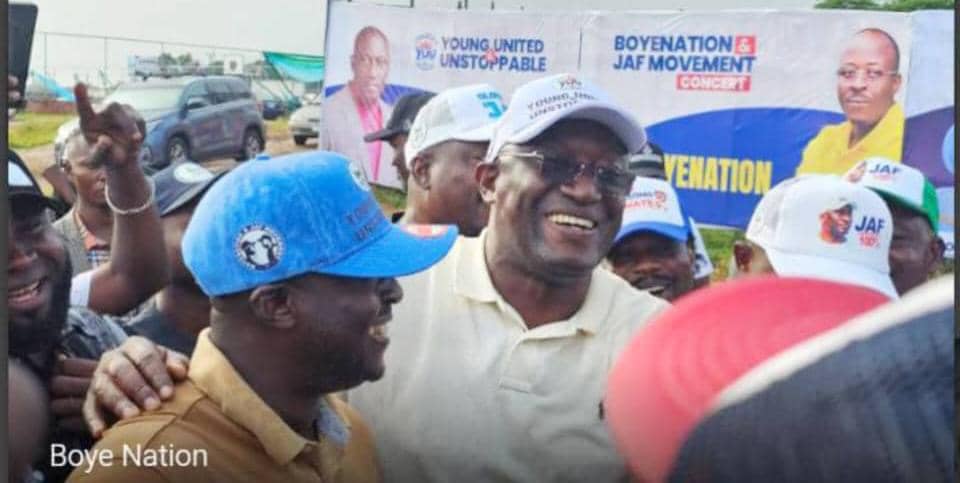
The same principle applies to the discussion around Boye.
If Boye is contemplating a political movement or a change of political platform, let the public examine his record, his ideas, his political relationships and his proposed agenda. If his political claims are weak, facts will expose them.
If his political argument is strong, voters will decide whether it deserves their support.
There is no need to manufacture insults around it.
The writer also spends considerable space discussing who is a “bonafide citizen” of Oyo State and who is allegedly a stranger.
That argument deserves caution.
Oyo State is home to people from different ethnic, religious and geographical backgrounds who have contributed to the economic, political and social development of the state.
Political citizenship should not be reduced to the place where a person’s parents were born.
If an individual is legally qualified to contest an election, the ultimate political authority belongs to the electorate.
That is precisely why elections exist.
If the people agree with a candidate, they will vote for that candidate.
If they disagree, they will vote for another.
No political writer, party, campaign organisation or online commentator possesses the authority to predetermine that decision on behalf of the people.
The most troubling aspect of the article is therefore not that the writer supports his preferred political camp. Everyone has a right to political preference.
The problem is the attempt to present political opposition as something deserving ridicule rather than scrutiny.
Calling people “parrots” does not answer their arguments.
Calling someone an “usurper” does not invalidate his political participation.
Calling opponents “mad” does not make one’s own position rational.
Predicting an “imminent defeat” does not make the defeat inevitable.
And invoking proverbs, no matter how colourful, does not replace evidence.
There is also a lesson for everyone participating in the 2027 political conversation: the electorate is not a political inheritance.
No individual owns Oyo State.
No party owns Oyo State.
No family owns Oyo State.
No political group owns Oyo State.
Oyo State belongs to its people.
Therefore, the final decision must be left to the voters.
Those seeking political office should tell the people what they intend to do.
Those defending incumbents should present their records.
Those challenging the government should present credible alternatives.
Those changing parties should explain their reasons.
And journalists and commentators should interrogate all sides fairly.
That is how democracy becomes meaningful.
The 2027 election should not become a contest of who can insult whom most creatively.
It should be a contest of ideas, records, programmes, character as publicly demonstrated, leadership experience and the capacity to address the concerns of the people.
Let the candidates defend their records.
And, ultimately, let the people decide.
Until then, nobody should mistake political confidence for political entitlement.
The ballot box, not insults, prophecies, ethnic sentiments or political noise will remain the legitimate instrument through which the people express their choice.
Oyo State deserves a political conversation worthy of its people.
It deserves facts over fiction, issues over insults and democratic competition over personal vendettas.
That is the standard we should all uphold.
Ajibola Ore-Ara-Ilu writes from Oyo State