












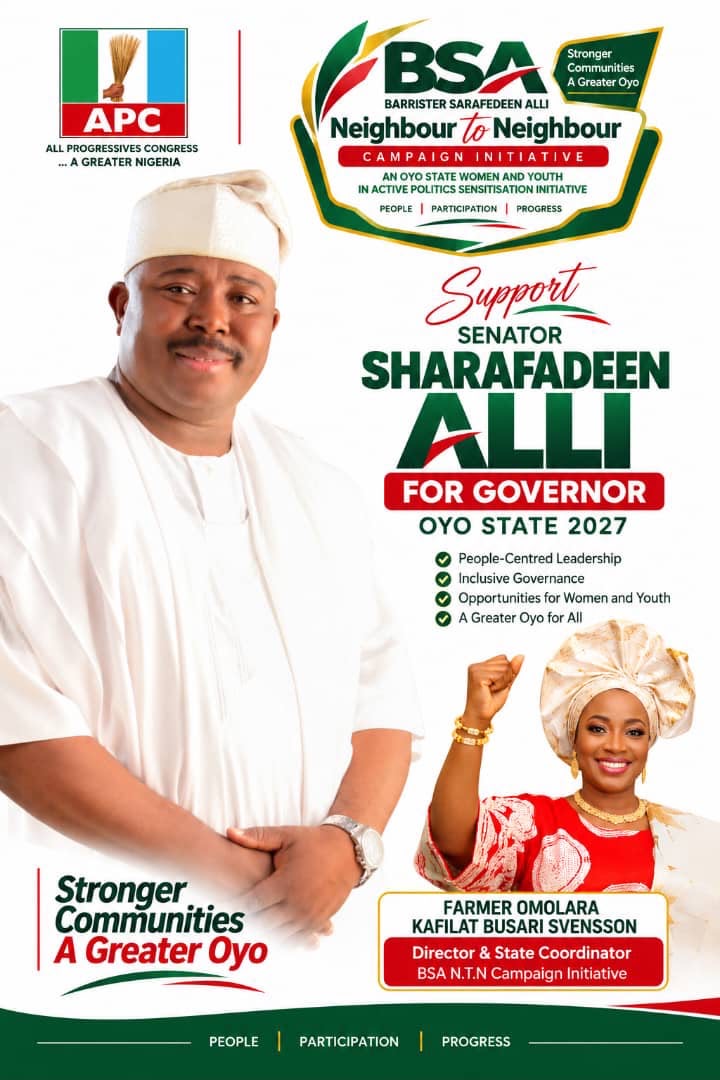
The recent declaration by the Aare Musulumi of Yorubaland, Edo and Delta States, Alhaji Dahud Makanjuola Akinola, that the 2027 Oyo State governorship should go to a Muslim, deserves a sober reflection.
As a Muslim, an Ibadan indigene and a proud son of Oyo State, I consider it important to express my position. This is neither an endorsement of any candidate nor opposition to any political party. It is simply a call for us to prioritise the future of our state above religious considerations.
There is absolutely nothing wrong with a Muslim aspiring to become governor, just as there is nothing wrong with a Christian seeking the same office. Both have equal constitutional rights. However, making religion the primary consideration for choosing a governor is a direction we should be cautious about, particularly in the 21st century.
The governorship of Oyo State is not a religious appointment. It is an enormous responsibility requiring competence, integrity, vision, administrative experience, accountability and the capacity to deliver development.



Our state needs a governor who can create employment for our teeming youths, improve education and healthcare, support farmers, strengthen security, attract investments, develop infrastructure and improve the standard of living. These are the real issues confronting our people, regardless of their religious beliefs.
Oyo State has enjoyed a long tradition of religious coexistence. Muslims and Christians have lived together, conducted businesses, intermarried and shared common aspirations. We must not allow political ambition to introduce unnecessary religious divisions into a society whose strength lies in its diversity.
Regarding the reported understanding between Muslim and Christian leaders ahead of the 2023 election, such an arrangement, even if established, should not become a substitute for the constitutional rights and democratic choices of the electorate. Section 42 of the Nigerian Constitution protects citizens against religious discrimination, while Section 177 outlines the qualifications for governorship without prescribing any religious affiliation.
Religious leaders have every right to express their political preferences, but spiritual leadership and political governance are two different responsibilities. Our religious institutions should promote values such as honesty, justice, compassion and accountability, which should be expected of every aspirant.
If a Muslim emerges as the most qualified candidate, let him earn the people’s support through his record, character, competence and vision. The same standard should apply to a Christian. We should not sacrifice merit on the altar of religious sentiment.
As Muslims, we should not be afraid of competing on merit. As Christians, nobody should feel excluded. Above all, as people of Oyo State, our collective interest must come first.
The question in 2027 should not be whether the next governor is a Muslim or a Christian, but who has the competence, character and vision to govern Oyo State and improve the lives of its people.