Politics, in this part of the country, often feels like a crowded marketplace where voices rise, banners compete for attention, and everyone insists they have the finest offering.
But every now and then, amid the noise, there is a stall people keep returning to, not because it is the loudest, but because they have tested what is being sold there before.
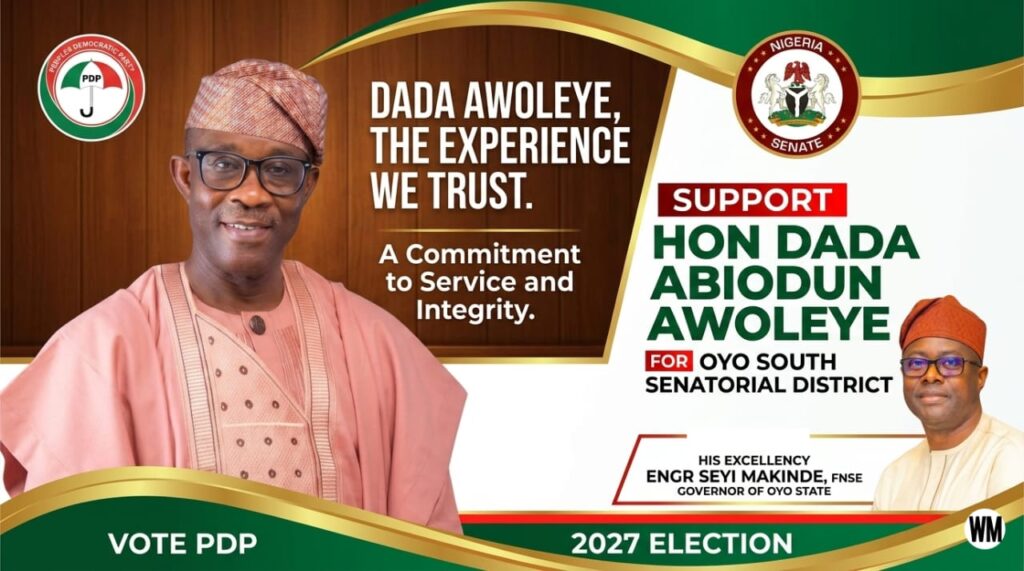
That is exactly where the story of Abiodun Dada Awoleye begins to settle in Oyo South Senatorial District.







It is less like a sudden rise and more like a path worn gradually by footsteps people remember for the track records and history of legislative excellence.
Not built on spectacle or sponsored media campaigns, but on moments that stayed with the people, conversations held, projects seen, and a presence that did not feel borrowed or distant like it is today.
Strip away the billboards, the talking points, the usual campaign rhythm, and what you find is something a bit more difficult to manufacture, a political career people can point to, not just argue about and this is a fact that can be fact checked from the streets.
A journey people actually witnessed
Long before Abuja came into the picture, Awoleye’s political life had already taken shape in the Oyo State House of Assembly.
It was there he built a reputation that still follows him like a shadow, not as a distant figure, but as someone who stayed within reach of the people he represented.
That early phase of his political career matters more than it may seem. It shaped a style that would later define his years at the national level, politics that leans toward presence, not performance for the cameras like politicians do today to sway public perceptions.
Indeed, Awoleye’s support has remained grounded in its organic form not purchased, and the sustained affection and love by his people is already a clear testament to this assertion.
When representation felt visible
Between 2011 and 2019, during his two terms in the House of Representatives for Ibadan North, Awoleye was not one of those lawmakers whose names disappeared after elections.
His time in office carried a certain visibility, both on the floor of the House and back home at his federal constituency.
No wonder he recently stated that he intended to construct a senatorial district office for his people for effective coordination of resource distribution across the nine local governments under the district with emphasis on correcting the imbalance that has long plagued the people of Ibarapa zone.
There were legislative efforts, including moves to improve infrastructure tied to Ibadan Airport, aimed at opening up the local economy.
But beyond that, there were the smaller, everyday interventions people tend to remember more clearly.
Boreholes in communities where water had long been a struggle. Construction of office for security post, support for local health centres and laudable programmes that directly reached young people trying to find their footing.
These are not the kinds of achievements that dominate national headlines or social media but they are the kind that stay with voters who are direct beneficiaries, and that’s one of the factors that defines the difference between leaving office and leaving the scene.
One of the quiet tests of any politician is what happens after power is gone. Do they fade, or do they remain part of the system they once served and continue to maintain political relevance?
Awoleye didn’t disappear. His continued involvement in politics and governance, including work around primary healthcare in Oyo State, kept him within the orbit of public service.
It also kept him connected to the same grassroots network that first brought him into office.
That continuity now looks less like coincidence and more like strategy, and that is why his name keeps coming up in the middle of every conversation around Oyo South senatorial district.
As conversations around the 2027 Oyo South senatorial race begin to take more visible form, certain patterns are already emerging. And one of them is very simple, his name keeps coming up as a political force, even in rooms where he is not being promoted.
Part of if is real time legislative experience at both state and national assemblies. Two terms in the House of Representatives is not just a minor credential.
It means familiarity with legislative processes, negotiation, and the realities of attracting federal attention to local needs through the instrumentality of lobby.
Part of it is also memory. Voters may debate politics endlessly, but they rarely forget tangible impact they felt not the ones that only existed on the pages of the newspapers.
And part of it is something harder to quantify, a sense that Awoleye is not starting from scratch at the National Assembly
Within the Peoples Democratic Party, especially with the strong influence of Governor Seyi Makinde in Oyo politics, the permutations for 2027 are still unfolding.
But in many of those internal conversations, one scenario has continued to repeat itself among leaders and critical stakeholders.
If Makinde is not on the ballot, who carries the weight of the party into a competitive senatorial race?
More often than not, Awoleye’s name has repeatedly surfaces because the party can not afford to gamble or treat the national assembly election as ordinary. The party knows well enough that the outcome of the first election could shape up subsequent governorship and state assembly polls.
This is not out of sentiment, but out of practical calculation that the Oyo state PDP can not feign ignorance of.
With his vast legislative experience, Awoleye represents continuity not dependency because, while he aligns with the broader direction of the current administration, his own track record stands on its own.
It is still early though, but Nigerian politics rarely follows a straight line, and elections have a way of rewriting expectations at the last minute but even now, something is beginning to settle.
This is not just another aspirant trying to build recognition through media noise and repetition. This is someone whose political identity has already been established in public view, tested in office, and carried in the memory of the people.
And in a race that will demand more than slogans and political dependency, more than visibility, more than carefully crafted messaging, that track record may count for more than anything else.
In Oyo South, the conversation is no longer just about who will run, it is slowly becoming about who other politicians would rather not have to run against.
And when Oyo South senatorial district is the subject, Dada Awoleye has remained a name others would pray didn’t find its place on the ballot, not for anything else, it is a force and a political threat to go head to head with in such a crucial contest.
Ibrahim Adekola writes from Yemetu, Ibadan.