

As the political landscape in Oyo State gradually shifts toward the 2027 governorship election, the All Progressives Congress (APC) faces a decision that will shape not only its electoral prospects but also the future direction of governance in the state.
Choosing a governorship candidate is never a routine political exercise.






















It is a strategic calculation that requires balancing party unity, electoral appeal, competence, and the capacity to inspire public confidence.
In a state as politically dynamic as Oyo, the stakes are even higher.
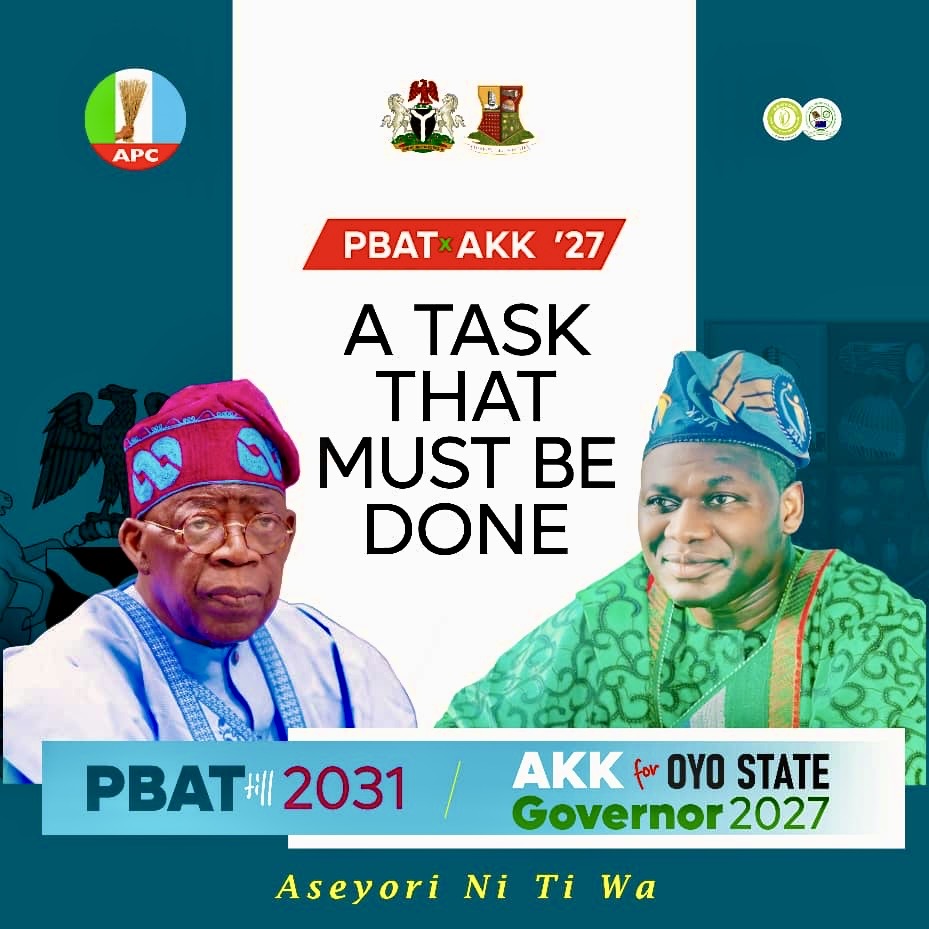
Within this context, Dr. Adewale Kolapo Kareem (AKK) increasingly stands out as a compelling option — a figure whose combination of strategic thinking, grassroots engagement, and forward-looking vision places him in a unique position within the party’s emerging leadership conversation.
A Vision Anchored in Policy, Not Slogans




One of the defining features of AKK’s political engagement is his emphasis on structured policy thinking.
In a political environment where campaign narratives are often driven by slogans and emotional appeals, AKK has instead focused on presenting a clear and documented vision for Oyo State.
His policy priorities revolve around key pillars critical to sustainable development:
Education reform and human capital development
Economic diversification and SME growth
Infrastructure renewal and modernization
Institutional accountability and governance reform
Youth and women empowerment
Such clarity reflects a leadership approach grounded in planning and measurable outcomes rather than rhetorical promises.
Grassroots Commitment Beyond Political Ambition
Perhaps the most persuasive aspect of AKK’s profile is that many of his initiatives predate his political ambition.
Long before entering the public conversation around governorship, he had already established a track record of community-based development.
Through various initiatives, he has facilitated interest-free loan schemes for traders, artisans, and small business owners, providing economic relief and opportunities for grassroots entrepreneurs.
He also oversaw the construction of a Central Masjid under the Wabillahi Taofeeq Islamic Mission Worldwide, while establishing educational institutions aimed at promoting both academic excellence and moral development.
In addition, he has invested in agricultural ventures designed to support food security and employment, founded a football club to nurture youth talent, and awarded scholarships to students, helping families overcome financial barriers to education.
His establishment of AB Travels and Tours has further expanded business opportunities while generating employment.
Beyond these initiatives, AKK launched the AKK House, an organized framework anchored on eight strategic pillars that focus on human capital development, economic empowerment, community support systems, youth advancement, women inclusion, agricultural productivity, faith-based moral development, and structured social impact programs.
What distinguishes these efforts is that they were undertaken without the benefit of political office, reflecting leadership motivated by conviction rather than position.
Global Perspective, Local Application
AKK’s professional exposure abroad — particularly in Australia — has provided him with valuable insight into governance systems that function with efficiency, accountability, and measurable results.
Yet his approach is not one of imitation. Rather than transplant foreign models wholesale, he advocates adapting global best practices to local realities, ensuring that reforms are both practical and culturally grounded.
This blend of international exposure and local sensitivity represents a leadership advantage in an increasingly interconnected world.
Respect for APC’s Progressive Tradition
APC’s political legacy in Oyo State carries the imprint of progressive governance, particularly under the administration of former governor Abiola Ajimobi.
AKK has consistently emphasized the importance of respecting party structures, sustaining institutional continuity, and building upon the achievements of previous administrations.
His consultations with party elders, stakeholders, and traditional rulers demonstrate a leadership style rooted in humility, consensus-building, and respect for established political structures — qualities essential for both party cohesion and electoral success.
Bridging Generations Within the Party
One of the emerging realities of Nigerian politics is the growing influence of younger voters. At the same time, the wisdom and institutional experience of senior party stakeholders remain indispensable.
AKK appears well positioned to bridge these two constituencies. His emphasis on innovation, entrepreneurship, and education reform resonates strongly with younger voters, while his measured tone and respect for party hierarchy reassure older stakeholders.
In this sense, he represents a bridge between generations — a strategic advantage in building a broad political coalition.
Temperament and Political Discipline
Political campaigns often generate noise and confrontation, but elections are ultimately won through credibility, discipline, and strategic communication.
AKK’s calm and issue-focused approach to political engagement reflects a temperament suited for leadership in a complex political environment.
His refusal to engage in divisive rhetoric enhances his credibility among undecided voters seeking responsible leadership.
Expanding APC’s Electoral Reach
For APC to reclaim Oyo State in 2027, the party must do more than consolidate its traditional base; it must expand its appeal to new segments of the electorate.
AKK’s grassroots initiatives, intellectual engagement, and connections within the diaspora community provide him with the potential to attract professionals, entrepreneurs, and first-time voters.
This ability to combine consolidation with expansion is central to any viable electoral strategy.
A New Phase of Leadership
Across Oyo State, there is increasing public sentiment for a leadership transition that balances experience with renewed energy. Within the commonly discussed 35–55 leadership age bracket, AKK fits naturally into the emerging profile of leaders capable of driving innovation while understanding governance complexities.
Faith, Identity, and Inclusive Governance
AKK is a practicing Muslim and holds the respected traditional title of First Fakhar Soliheen of Oyo State, meaning The Pride of the Righteous of Oyo State.
However, while his faith forms an integral part of his identity, his leadership philosophy emphasizes inclusivity and development-driven governance — ensuring that all citizens, regardless of religious affiliation, feel represented and protected.
The Strategic Question Before APC
As APC prepares for the political contests ahead, the question confronting the party is both strategic and consequential.
The 2027 election will require a candidate capable of combining vision with structure, ambition with humility, and global perspective with grassroots credibility.
Dr. Adewale Kolapo Kareem embodies many of these attributes.
For a party seeking not merely participation but victory, the decision about its governorship flag bearer will be pivotal.
And in that decision lies a fundamental question:
Who best represents the future Oyo State deserves?