
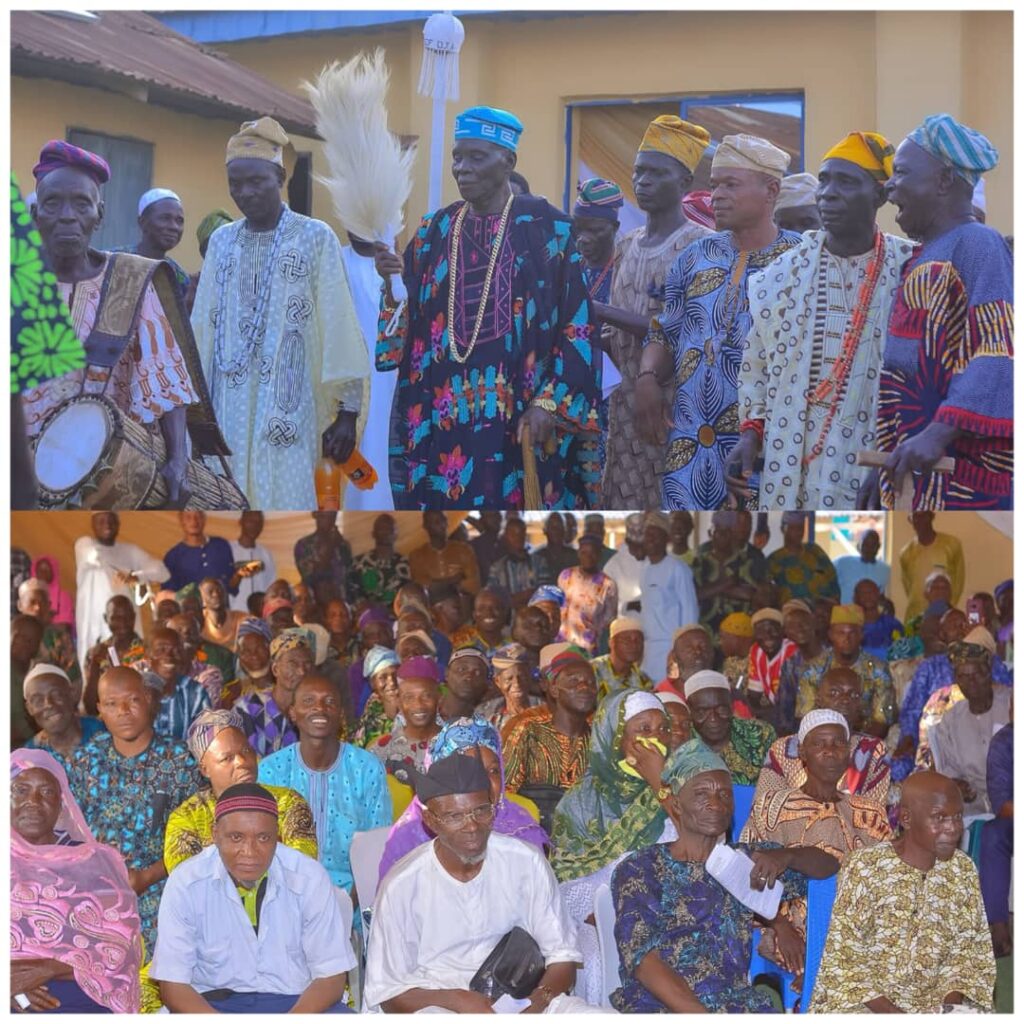
The Palace of His Royal Majesty, Oba Ganiyu Ajiboye Busari Arogundade II, the Alágo-Oja of Ago-Oja, has reaffirmed the distinct historical identity and traditional status of Ago-Oja, rejecting attempts to substitute the community’s name with “Isale-Oyo.”
The position was reiterated during a stakeholders’ meeting held with residents at the Ago-Oja Palace Hall on Sunday, October 4, 2026, where the monarch, palace chiefs, legal representatives and community stakeholders addressed recent public discussions surrounding the traditional institution and the historical identity of the community.



























In his welcome address, the Alágo-Oja maintained that Ago-Oja has a distinct historical and cultural identity, urging residents and stakeholders to remain peaceful, law-abiding, and committed to the preservation of the community’s heritage.
The monarch also commended his traditional chiefs and members of the community for what he described as their continued support for the traditional institution and the peace and development of Ago-Oja.
Addressing the controversy surrounding recent reports about court proceedings and the status of the Oloja stool, the monarch described some of the claims circulating in the public domain as inaccurate, urging members of the public to await official legal documents rather than relying on unverified reports.
The monarch maintained that there has been no official communication, to his knowledge, declaring his installation invalid or dethroning him from the Ago-Oja traditional stool.





He further recalled the process leading to the recognition and installation of the current Alaafin of Oyo, Oba Akeem Owoade, stressing that he had participated in the traditional and governmental processes preceding the monarch’s emergence.
The Alágo-Oja also expressed appreciation to the Oyo State Governor, Engr. Seyi Makinde, and Senator Monsurat Olajumoke Sunmonu for what he described as their support for the traditional institution.
Speaking on the legal dimension of the controversy, Barrister S.O. Raheem argued that the issues surrounding an earlier court case involving the Baale status should not be confused with the present status of the Alágo-Oja.
According to him, the case being referenced relates to an earlier period and should not automatically be interpreted as a determination of the present status of the traditional institution.
Raheem further pointed to the state government’s recognition and coronation of the Alágo-Oja as a monarch, arguing that the relevant government instrument and subsequent recognition should be considered in assessing the current status of the stool.
He urged members of the public to distinguish between historical litigation concerning the Baale designation and the subsequent governmental processes relating to the conferment and recognition of the Alágo-Oja title.
The lawyer maintained that, until there is a formal and legally binding pronouncement specifically invalidating the monarch’s present status, reports suggesting that the Oloja has been dethroned should not be treated as fact.
A major issue raised at the gathering was the identity and historical nomenclature of the community.
The Palace declared that the community is historically known as “Ago-Oja” and should not be replaced by the designation “Isale-Oyo” in official records, media reports, maps, or public documents.
The Palace said the position was not intended to challenge the authority or cultural significance of the Alaafin institution, but rather to preserve what it described as the distinct history, heritage and traditional identity of Ago-Oja.
The Palace further appealed to government agencies, mapping organisations, researchers, historians and media organisations to recognise and consistently use Ago-Oja in their records and publications.
According to the Palace, respect for the Alaafin institution and the broader Oyo civilisation can coexist with the preservation of the historical identity of Ago-Oja.
The Palace also called for a scholarship-based approach to discussions concerning the history of Ago-Oja, referencing historical writings which, according to the Palace, documented the role of Oja and Ago-Oja in the development of the settlement associated with New Oyo.
It stressed that the community’s insistence on retaining its historical name should not be interpreted as an attack on the Alaafin institution or an attempt to create hostility between traditional institutions.
Rather, the Palace said, it is seeking recognition of Ago-Oja’s historical identity and the preservation of its cultural heritage for present and future generations.
As part of efforts to deepen cultural consciousness and promote unity, the community announced plans to establish an annual “Ago-Oja Day”
The initiative, according to the Palace, is intended to celebrate the community’s history, promote peaceful coexistence, encourage development and strengthen the connection between younger generations and their ancestral heritage.
The Palace also called for streets and public references within the community to reflect the Ago-Oja nomenclature, in line with the historical and traditional identity being promoted by the community.
In separate remarks, Ogundiran Simeon, Lanre Akintola, Nusirat Ologede and Luqman Hamzat expressed their support for the traditional institution and assured the monarch of their readiness to protect and promote the heritage and institutional integrity of Ago-Oja.
They called for unity among residents and urged stakeholders to approach the ongoing discussions with maturity, restraint and respect for the rule of law.
The Palace, while acknowledging the public debate surrounding recent Supreme Court proceedings, said it would continue to rely on formal legal and traditional channels rather than speculative public commentary.
It stated that any official action considered necessary would be taken after receiving appropriate formal communication from the relevant parties.
The Palace’s position was summed up in a clear message: Ago-Oja has its own name, history, heritage and traditional identity.
It reiterated its respect for Oyo, the Alaafin institution and Yoruba traditional values, while insisting that such respect should not require the abandonment of the community’s historical identity.
The Palace therefore appealed to government institutions, traditional authorities, the media and the general public to promote peace, historical accuracy and mutual respect in all discussions concerning Ago-Oja.
“Ago-Oja remains Ago-Oja”, the statement concluded.